

Imagine a life of constant tremors.
A glass of water becomes a sprawling puddle. Buttoning a shirt becomes threading a camel through a needle’s eye. Taking one step becomes walking on black ice.
Combine this with pain, uncontrollable sweating, mental health issues, and loss of smell. This is the daily life of someone who suffers from Parkinson’s disease.
Now imagine a brief period of respite.
Lofty ceilings stretch above. Reflective walls surround. Light spills in luminous fluorescence.
Symphonic classical melodies pulsate through the air, limbs sway to the rhythm, and smiles spread across faces.
And as the session draws to a close, a moment of forgetfulness follows.
Not of life. Not of things. Not of words.
Liberation from their ailment.
A walker is left abandoned as the patient absentmindedly exits. Instructors rush to stop her. Half the room is concerned. But, nearly all are in awe.
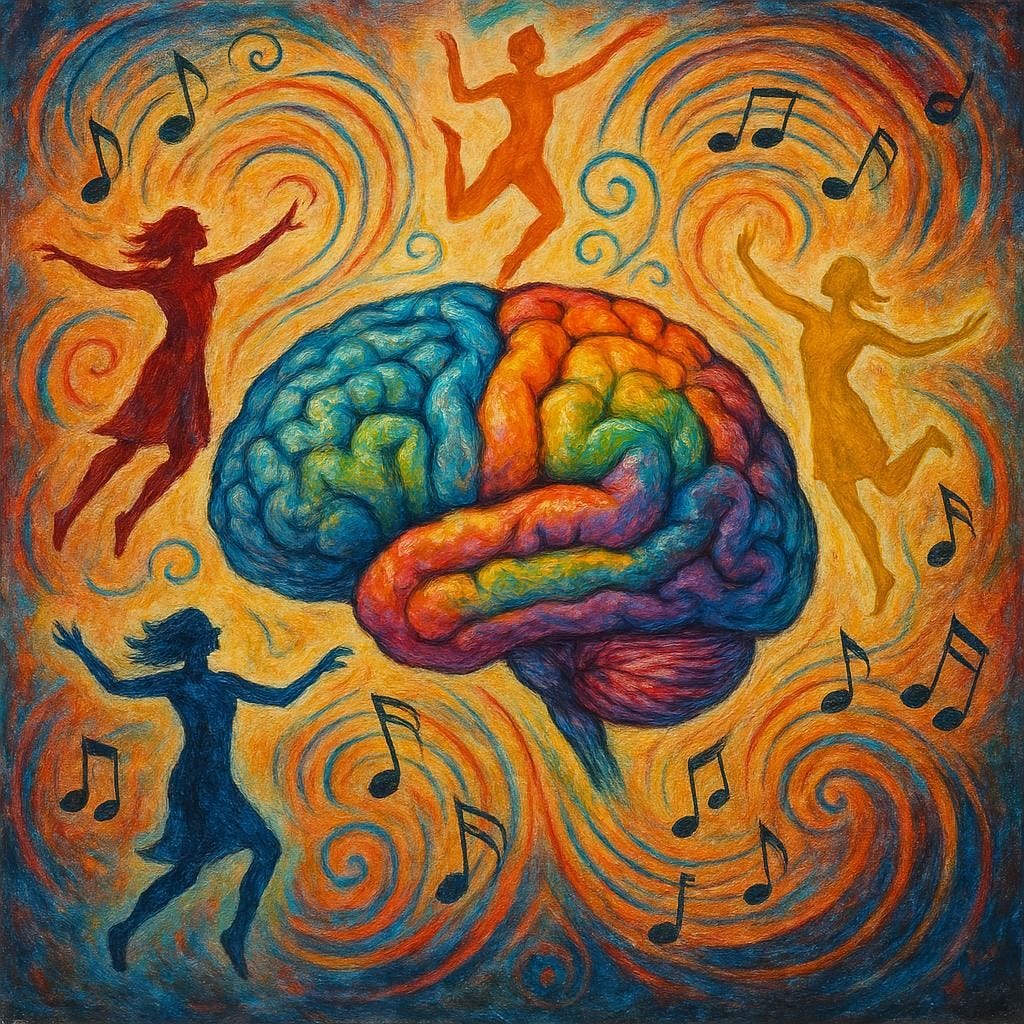
This is the power of art on the brain. This is NeuroArts.
NeuroArts is a powerful interdisciplinary movement that has swept through the neuroscience field, gaining traction at high profile institutions such as Johns Hopkins University, University of Minnesota, and Florida Atlantic University.
And I am intimately familiar with it.
As a high school senior and full-time student at Boca Ballet Theatre—a pre-professional ballet company in Boca Raton, Florida—I had the privilege to volunteer as an assistant instructor in BBT4PD, Boca Ballet’s dance for Parkinson’s disease outreach program.
Every session was profound. I witnessed patients experience moments of pure joy as music and movement momentarily whisked them away from their affliction. Caregivers joined in the delight, finding their own brief reprieve from the toll of their labor.
And overall impacts were not short-lived.
The true story depicted above demonstrates something neuroscientists have begun to recognize worldwide. Art forms such as dance can facilitate neuroplasticity, promoting healing by rewiring the brain to compensate for neurological challenges.
Boca Ballet Theatre is not the only institution in South Florida tackling the field of NeuroArts head-on. In 2022, the Palm Beach County NeuroArts Collaborative was established by the Palm Health Foundation to assemble scientists and artists to advance this growing field in the local area.
Acting as pillars of research support for this expanding PBC NeuroArts ecosystem are Florida Atlantic University’s Stiles-Nicholson Brain Institute and Max Planck Florida Institute for Neuroscience, located in the neuroscience research hub in Jupiter, Florida. FAU’s Executive Director, Dr. Randy Blakey, is featured in numerous snapshots on the Collaborative’s website, showcasing his avid support for the field.
And even prior to this, Johns Hopkins University identified NeuroArts as a discipline worthy of attention. In 2016, they founded the International Arts + Mind (IAM) Lab “with a mission to study the intersection of brain sciences and the arts and to bring research to practice.” Three years later, the IAM Lab partnered with the Aspen Institute to develop the NeuroArts Blueprint Initiative, which currently serves as a foundation for all further NeuroArts advancement in the US and worldwide.
Even the Palm Beach County NeuroArts Collaborative is based on their framework.
Moreover, at the University of Minnesota, their NeuroArts Network is in-house but robust, drawing together diverse faculty and staff members “with an interest in research at the intersection of the arts, wellbeing, and neuroscience…to use the network to disseminate information and resources to foster collaboration.”
Based on all of these examples, one thing is clear. The art of science is diffusing throughout the field of neuroscience, And as they draw together interdisciplinary experts, they succeed in creating brilliant masterpieces that profoundly transform lives.